PALASH
| संस्कृत: | पलाश , किंशुक | ગુજરાતી: | ખાખરો , કેસૂડો | |
| हिन्दी: | खाखर , धाक | Binomial: | Butea monosperma |
Introduction:
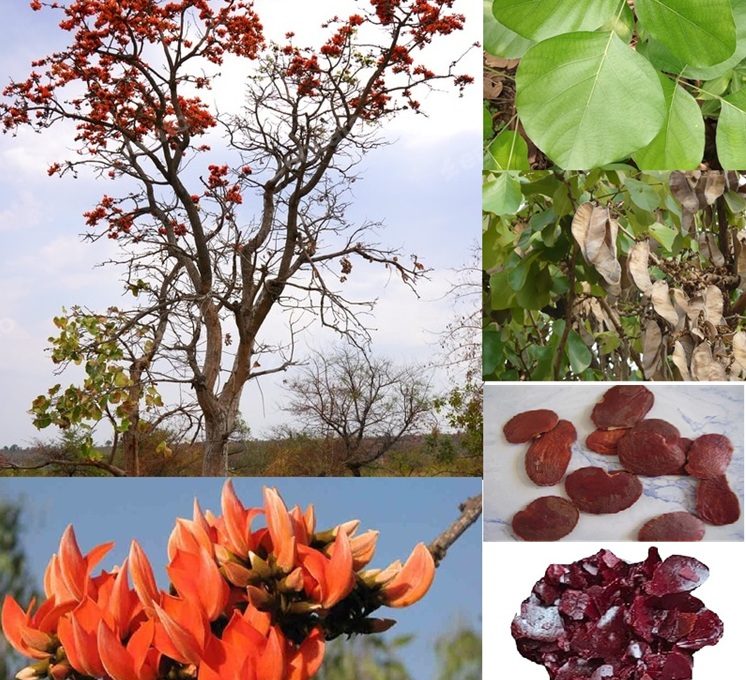
Palash trees are found all over India, has medium height. Dark green leaves are thick and ovate, arranged in pinnate shape, usually three leaves on the stem. Flowers are vibrant orange red with many petals arranged to look like a beak, hence called kinshuk and flame of fire. Thick skinned fruits-pods are 10-15 cm long and 2-5 cm wide, containing kidney-shaped seeds brownish in colour. The bark, leaves, flowers, stems, seeds, gum, and roots are used in ayurveda. Leaves are widely used to prepare food plates; flowers are used to prepare Holi colours and wood pulp is used in paper industry. The tree is considered very auspicious, and reference is found in Charak and Shushruta Samhita.
Uses:
1. 1-3 grams of seed powder is given with honey to remove intestinal worms.
2. Apply paste of palash fruit rubbing in neem leaves juice on affected part in chickenpox.
3. To treat dry cough and stomatitis, suck the juice of palash leaf stalk after keeping it in mouth.
4. Fresh flowers are soaked in water for few hours and are used to take bath to maintain skin glow. Powder of dried fruits is used to prepare paste and applied on affected part to restore decolorization of skin.
5. Boil dried flowers in water, strain it, add surokhar (Potassium Nitrate) and drink to relieve difficulty in urination.
6. Palash bark decoction is given to treat irregular menstruation. Give 12 to 15 prior to expected date of menstruation for 2-3 cycles.
7. Decoction of bark is given by adding rock salt to relieve congestion and breathlessness.
8. Flower paste is applied on scalp to remove dandruff, helps in hair growth as well.
9. To treat joint pains, crush fruit, add honey and apply externally to the affected part.
10. For treatment of hemorrhoids, one gram of kamarkas (Resin) of palash tree is mixed with warm water and consumed.
11. 1 gram of kamarkas (Resin) of palash tree is given with crystallized sugar to treat dysentery.